לאתר בעברית ↗
LITERATURE · LAW · JEWISH TEXTS

Yair EldanWriter, poet, scholar

At the meeting point of law, narrative, and human relationships.

“People tend to forget, for various reasons, some of them justified, that a law is also a poem”

Laws Like Poems

Portrait of Yair Eldan
Yair Eldan · Photo: Yifat Zilbershtein

About

Yair Eldan is an Israeli writer, poet, and scholar who teaches at the Faculty of Law at Ono Academic College. His work moves among law, literature, Jewish texts, and conflict studies. He completed his undergraduate studies at the Hebrew University of Jerusalem and his doctorate at Bar-Ilan University. His research on excommunication in rabbinic literature led to a sustained interest in how communities define boundaries, exercise authority, and negotiate disagreement.

In Excommunication, Death and Mourning he examines the boundaries of community in rabbinic literature. His novel Law Life explores power, gender, and relationships through the notebooks of a fictional leader. Laws Like Poems collects essays on law, politics, and culture.

Contact: yair.eldan@gmail.com

Books

כריכת הספר נידוי, מוות ואבלות
Excommunication, Death and MourningResling, 2011

A study of excommunication and mourning in rabbinic literature.

Book details ↗
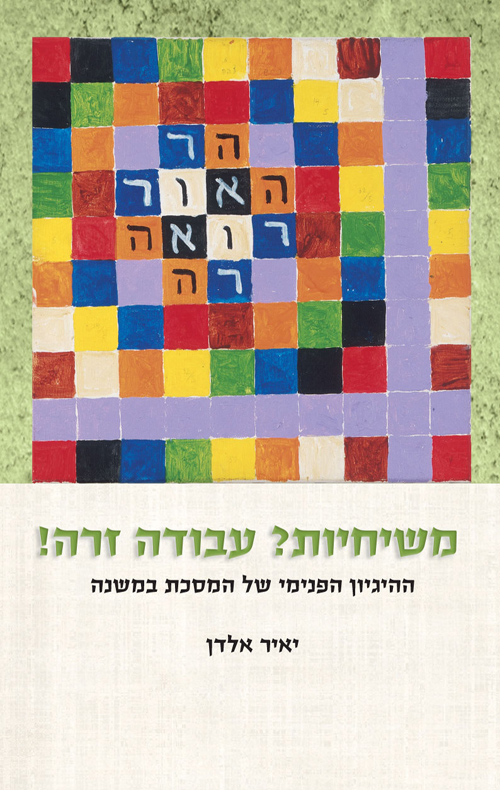
כריכת הספר משיחיות? עבודה זרה! ההגיון הפנימי של המסכת במשנה
Messianism? Idolatry! The Internal Logic of the Tractate in the MishnahCarmel, 2011

A reading of Mishnah tractates as complete works with an internal logic.

Book details ↗
כריכת הספר מפת הגוף
The Body MapFiction · Yediot Sfarim, 2011

A work of fiction by Yair Eldan.

Book details ↗

Cover of Since I Saw You Last by Orna Reuven and Yair Eldan
Since I Saw You LastWith Orna Reuven · English edition, 2026

A novel co-written with Orna Reuven.

Originally published in Hebrew as The Letter (Keter, 2016).

Buy on Amazon ↗Hebrew edition ↗
כריכת הספר משהו רוחני זורם כביכול
Those Blessed StructuresWith Shulamit Almog · Carmel, 2021

A collaborative work with Shulamit Almog.

Book details ↗
כריכת הספר חיי חוק
Law Life: Three Notebooks by Neomi YahavFiction · Yediot Sfarim, 2023

Three notebooks tell of Naomi Yahav’s rise to power and fall in a fictional Israel.

Book details ↗
כריכת הספר מה שהיה להוכיח
Come and HearPoetry · HaTahana, 2026

Poems moving among memory, relationships, war, and daily life.

Book details ↗
כריכת הספר חוקים כמו שירים
Laws Like PoemsEight short essays on law, politics and culture · Resling, 2026

Eight short essays weaving together law, politics, and culture.

Book details ↗

Articles & chapters

Political, Judicial, and Artistic TimeIn Laws Like Poems: Eight Short Essays on Law, Politics, and Culture · Resling, 2026, pp. 11–27Published in Hebrew; English translation availableRead original (Hebrew PDF)Read English translation (PDF)
The Jewish-Israeli Trauma Archetype (and on the Possibility of Jewish Archetypes in General)In Laws Like Poems: Eight Short Essays on Law, Politics, and Culture · Resling, 2026, essay 8, pp. 97–110Published in Hebrew; English translation availableRead original (Hebrew PDF)Read English translation (PDF)
“You Shall Not Stand over the Blood of Your Neighbor”: The Evolution of an Idea and Its Impact on Israeli SocietyAkdamot 11, pp. 7–37Published in Hebrew; English translation availableRead article (Hebrew PDF)Read English translation (PDF)
Entering the Garden of Eden: Agnon as a Midrashic Creator and Social CriticDeot 17, pp. 35–37Read article (Hebrew PDF)
The Jewish Pursuit of Uncertainty through Imagination: Patterns of Jewish Identity in the Debate over Adopting a ConstitutionAkdamot 16, pp. 109–134Published in Hebrew; English translation availableRead article (Hebrew PDF)Read English translation (PDF)
“Home” and “Revelation”: Metaphors in the Space of Conflict over the Constitution in Israel’s Early YearsOrganizational Analysis 12 (2007), pp. 32–47Published in Hebrew; English translation availableRead article (Hebrew PDF)Read English translation (PDF)
Mishnah Taanit: A Phenomenology of a Community Living in the Shadow of OstracismAkdamot 19, pp. 165–182Published in Hebrew; English translation availableRead article (Hebrew PDF)Read English translation (PDF)
“With Us in All Our Trials”: A Reading of Appelfeld’s The MetamorphosisIn Twenty-Four Readings in Aharon Appelfeld’s Literary Work, ed. Avidov Lipsker and Avi Sagi (Bar-Ilan University Press and Shalom Hartman Institute, 2011), pp. 499–513Published in Hebrew; English translation availableRead article (Hebrew PDF)Read English translation (PDF)
Tractate Makkot: Offenders, the Commutation of Punishment, and What Lies between ThemChapter One of Messianism? Idolatry! The Internal Logic of the Tractate in the Mishnah · Carmel, 2011Published in Hebrew; English translation availableRead chapter (Hebrew PDF)Read English translation (PDF)
Tractate Sotah: Destruction, Leadership, and MessianismIn Messianism? Idolatry! The Internal Logic of the Tractate in the Mishnah · Carmel, 2011Published in Hebrew; English translation availableRead chapter (Hebrew PDF)Read English translation (PDF)
Evel Rabbati (Semahot): Death Anxiety and the Work of MourningIn Messianism? Idolatry! The Internal Logic of the Tractate in the Mishnah · Carmel, 2011Read article
A Proposed Reading of Tractate Shabbat: Closing the Door of the HomeIn Messianism? Idolatry! The Internal Logic of the Tractate in the Mishnah · Carmel, 2011Published in Hebrew; English translation availableRead article (Hebrew PDF)Read English translation (PDF)
Laws Tell Stories: An Introduction to a Large-Scale Reading of Laws and TractatesIn Messianism? Idolatry! The Internal Logic of the Tractate in the Mishnah · Carmel, 2011Published in Hebrew; English translation availableRead article (Hebrew PDF)Read English translation (PDF)
Disgust in Law: A Reading of Tnuva v. RabiWith Yofi Tirosh · in Studies in Food Law, 2017, pp. 375–409
Milk, Adulteration, Disgust: Making Legal MeaningWith Yofi Tirosh · in Making Milk, ed. Mathilde Cohen and Yoriko Otomo, 2017, pp. 99–116Published in EnglishRead chapter (PDF)
Laws Like PoemsIn Laws Like Poems: Eight Short Essays on Law, Politics, and Culture (Resling, 2026), pp. 29–37 · Odot 9, 2018 ↗Published in Hebrew; English translation availableRead original (Hebrew PDF) Read English translation (PDF)
“There Is a Place Beyond the Forest”In Laws Like Poems: Eight Short Essays on Law, Politics, and Culture (Resling, 2026), pp. 39–52Published in Hebrew; English translation availableRead essay (Hebrew PDF) Read English translation (PDF)
Classroom and DemocracyIn Laws Like Poems: Eight Short Essays on Law, Politics, and Culture (Resling, 2026), pp. 87–96Published in Hebrew; English translation availableRead original (Hebrew PDF) Read English translation (PDF)
Subversive Transitions: On Gilad Meiri’s “Bo Zmani”Iton 77, issue 399, 2018, p. 14Read article ↗
Life After Reading: On Orit Meital’s “Loteshet Ayin”Iton 77, issue 432, 2023, pp. 14–15Read article
LAWWith Shulamit Almog · Falling in Law, July 2026Published in EnglishRead article ↗

Further publications and papers are available on Academia.edu.

Poems

Five poems in English, including two from Temple Poems.

Poetry

To say: good, but I object. Or: I object, but it is good. Or shorter: but it's, but good. Or even shorter: but.

Writers and Traitors

Writers are the biggest traitors of all, not because They treat people as literary characters, and not because They present themselves as Jack or Robert, while gathering, undercover, more and more information, and not because, they say, in an interview that their writing is not political so they can sell books, and not because they justify every injustice by claiming that this world is Auschwitz. And they are not the biggest traitors of all because they talk highly of the singularity of every human being while placing foundations for one humanity, and not because you cannot predict the reaction of the readers to their writings. Writers are the biggest traitors of all because they make you wonder If there is anything called treason at all. While the dumb poor blind poets See it everywhere.

The writer's Naivety

There is no demand for the one and only thing I am good at. They need me now more than ever.
Temple Poems

“And let them make me a sanctuary; that I may dwell among them” (Exodus, 25:8)

The Table

I’m dying to be laid out like a sushi girl, like the holy bread on the Table. My skin looks as if it was pierced and starts to speak table-ism in bright red dots. Slowly the desire to overturn tables softens, my back settles and the sounds of chewing are loud in my ears, Don’t stop touching me.

The Bronze Altar

I was the altar once, and once she played with my pans and shovels and fleshhooks. And like doctors we wrapped our hands in sandwich bags. the end of curiosity, our sacrifice, was supposed to be harsh and cruel, but like a wounded animal it got stronger with our mutual burrowing and then I knew that, like Isaac, I’d be okay, and so would she.

Research & teaching

Eldan researches and teaches Jewish law, jurisprudence, law and literature, and religion and conflict management. His teaching brings the Bible, Mishnah, Talmud, and literature into conversation with legal theory to examine authority, resistance, reconciliation, and the possibility of living with disagreement.